At Home / Guide
Choose everyday cushion fabrics
Compare removable cover fabrics for the seat people lean on and the laundry routine you can keep.
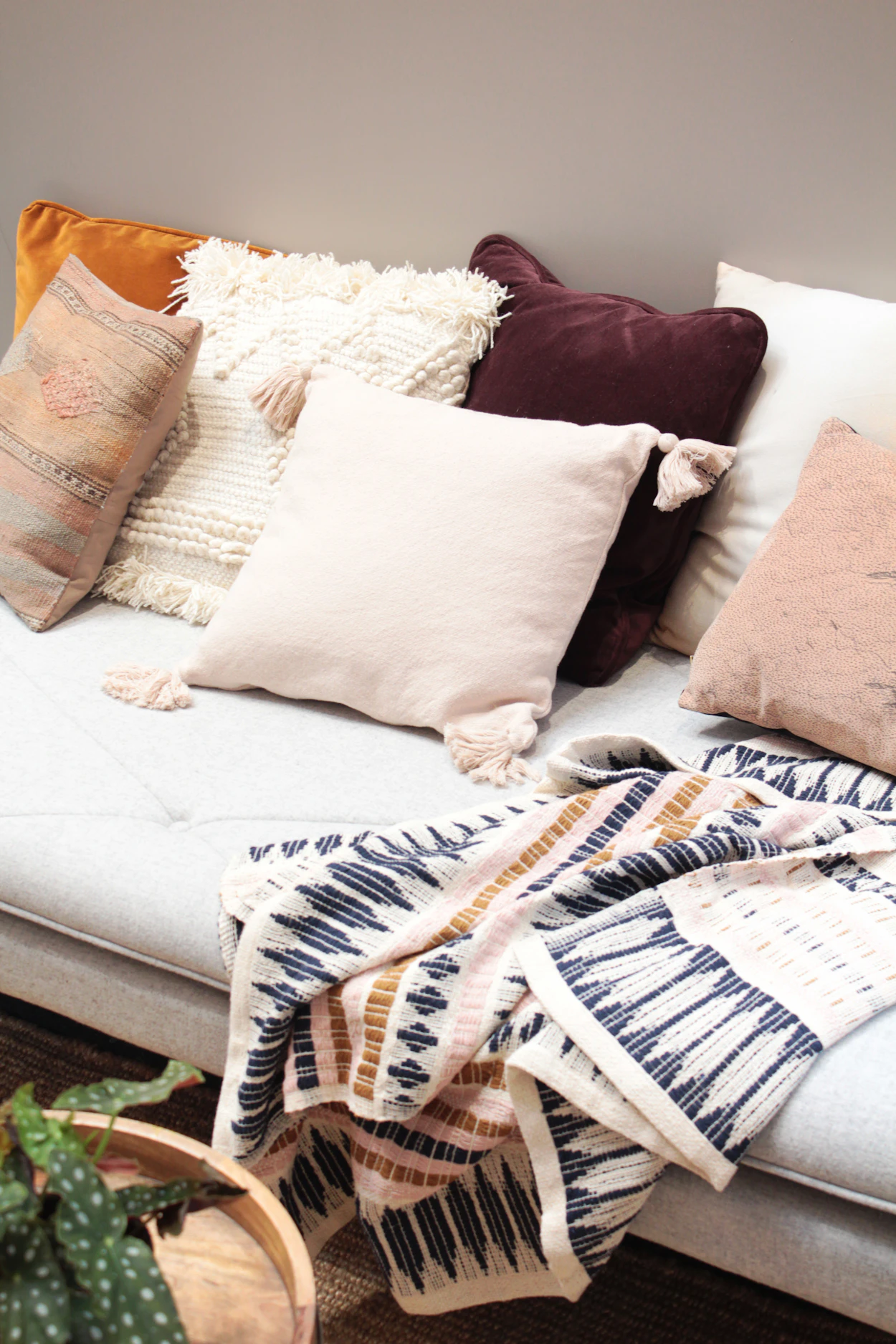
Describe what happens to the cushion in a normal week
Choose one loose cushion that gets used rather than one that mainly sits upright in a photograph. Notice who leans on it, whether it moves across the sofa, and which edge gets picked up when it is moved. The fabric on the side that touches a sleeve or cheek may matter more than the side you see from across the room. Think about whether you remove the cover after a spill or tend to leave it on and clean just the spot. These habits determine whether a beautiful finish with a demanding care routine will get used at all.
Decide which three conditions the fabric must satisfy before comparing color. Perhaps the cover has to come off easily, feel smooth against a bare arm and tolerate the cleaning method written on the label that you can actually use. For a cushion close to a sunny window, ask the seller what information they have about fading rather than inferring resistance from the darkness of a small swatch. For a scratchy summer cover, keep that one as a comparison. A familiar problem is a better yardstick than a general wish for fabric that will last a long time.
Compare surface, body and the view around an edge
Hold the same area of each sample across the rounded insert rather than comparing a stiff swatch and a crumpled one. Sit and lean against the sample over the old cover. Some flat wovens feel crisp, others soft; some textured cloths give useful grip and others catch against a sleeve. A compact weave may suit the seat better than open loops where clothing hardware often brushes the cushion. The fiber name alone does not tell you how tightly the cloth is woven or what its surface will feel like at the corner under pressure.
Lift the sample away and hold it against a light and a dark piece of spare cloth. If the insert or its labels show through, consider whether a lining would add too much bulk or whether a more opaque fabric would solve the problem in one layer. Fold the sample over itself to approximate a sewn seam near the zipper. A heavy fabric can make a confident front panel and still be awkward in the seam allowance or at a sharp corner. Conversely, a thin fabric may be easy to turn but show every lump in the insert. Choose the combination, not merely the swatch.
Read care and abrasion in the right order
Check care instructions for the finished removable cover, or for each component if you plan to sew it. Do not assume that a zipper makes an item machine washable. Backing, piping, dye and zipper tape may influence the finished instructions. If the fabric is sold for sewing and allows home laundering, mark dimensions on a sample large enough to handle without stretching the edges and follow the permitted wash and dry routine you intend to use. Measure again after it has dried and check for a change in hand or surface. Do not use a reassuring result on one fabric to authorize the same treatment on the other.
If the seller lists an abrasion result, record the named method and what fabric it refers to. The Association for Contract Textiles notes that abrasion results do not reliably predict a fabric's lifespan; do not rank results from different methods as though they were counts on the same scale. A few rubs with your shirt sleeve can help you decide whether you dislike its grip or whether it catches easily on that sleeve. Such a check tells you about the interaction you just tried, not about years of wear. Where a color appears to transfer during handling, ask about the appropriate care or colorfastness information before putting it on pale upholstery.
Try two sensible options on a busy seat
Imagine a reading cushion with a dark insert that gets moved from armrest to lap most evenings. A pale tightly woven cloth feels smooth but makes a dark label on the insert visible; a mottled thicker cloth hides the label but its surface drags on a sweater. Drape each around the same side of the cushion and see whether moving the label out of the front of the cover, or using the insert with its usual inner casing, solves the show through. If it does not, consider a third opaque cloth with a smoother face instead of picking between two problems you will notice every day.
Suppose the same pale cloth feels good when dry but you expect to launder it often because it sits beside the kitchen. A care compliant sample starts with a marked 10 inch span and finishes dry at 9.75 inches in one direction. That is a quarter inch over the sample span, enough to investigate before making a very fitted cover, but not a promise that the finished cover will shrink by exactly the same proportion. Prewash the sewing yardage if permitted and consistent with how you trialed it, then cut to pattern; for a purchased cover, check its finished size and care with the seller rather than adding a guessed allowance.
Keep one cover through the full routine
Make or buy one cover before committing to matching covers across the room. Sit with the cushion and get up as usual. Look for a seam that rotates into view, an edge that catches on clothing and a cover that slips on the seat. A seam that binds while fitting may be a shape or opening problem; fabric texture will not make a short opening longer. If you sew, try the intended opening treatment on a scrap sandwich to see how the machine feeds the layers and whether the closure leaves a ridge you can feel.
Remove the cover using the intended opening and put it back on after the care cycle permitted by its directions. Look at fit, whether the cover remains comfortable and anything you still need to fuss with before it goes on the sofa. Keep notes with the fabric reference, which direction the face was cut and whether you would change the closure. If the fabric passes but the fit fails, alter the cover pattern before cutting more. If the cover fits yet no one wants to lean against it, find a more agreeable surface rather than repeating the purchase for visual symmetry.