Fabric Notes / Guide
Read a fabric’s drape before buying
Use a fold and a pinch test to tell what will hang softly and what will hold a shape.
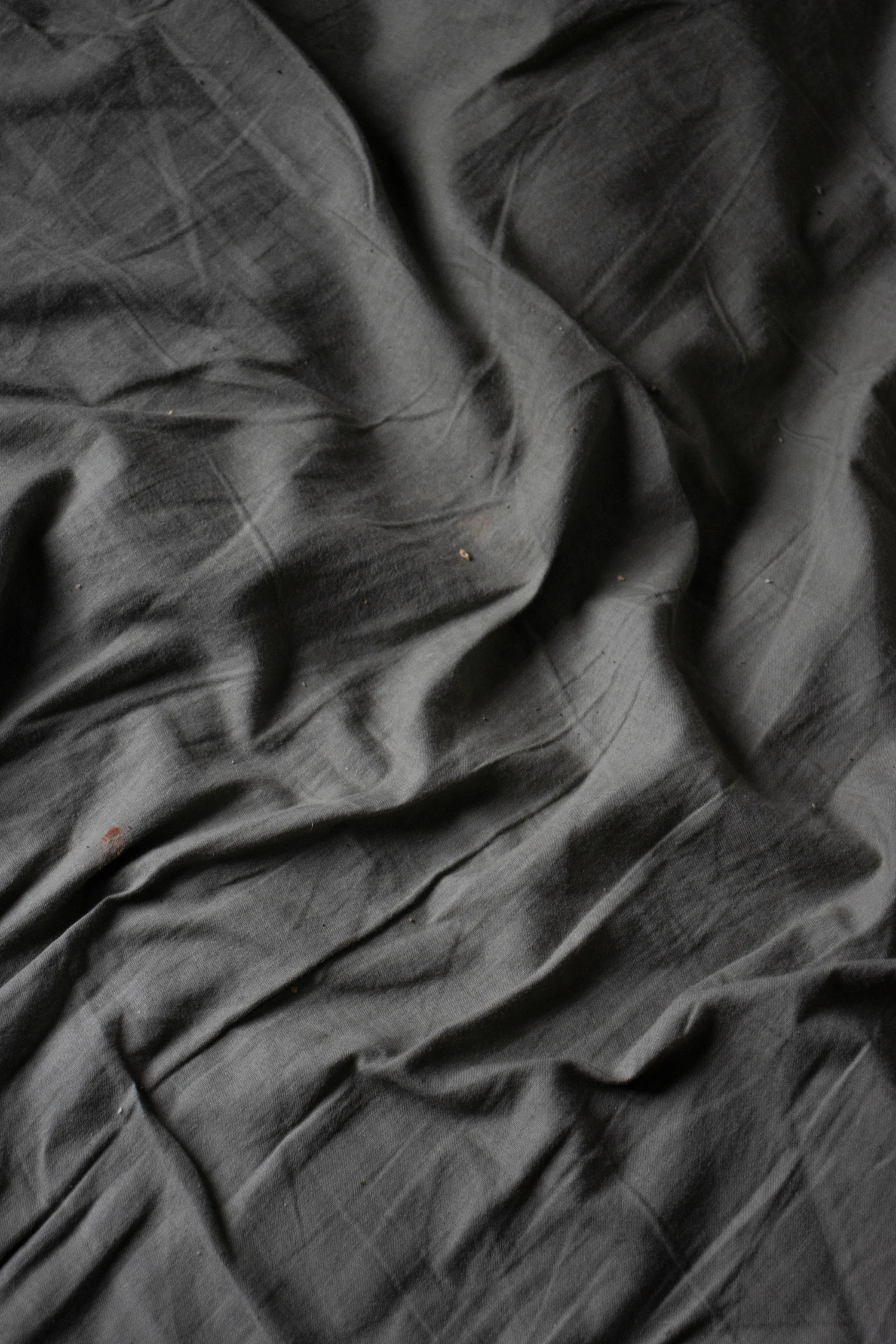
Decide which shape must hold and which must fall
Recall a textile that already has the movement you want. The side of a cafe curtain may fall in narrow relaxed folds, while a lined basket beside the sewing machine needs to keep a rim standing up. For a cover on a big floor cushion, you may want the face to bend easily around the insert but the opening to keep its shape while you close it. Note where the material is supported and where it hangs free. Fabric on a flat cutting table gives very little evidence about how that transition will look after the object is made.
Distinguish a deep crease from a soft fold. A crease can stay sharply visible even after you release the fabric; a fold is the curve it takes under support and its own weight. Weight, thickness and drape need not move together. One heavier cloth may fall close to the edge while a lighter, stiffer one projects outward. If a sharp ridge is the thing you want to avoid, say so on your sample card rather than simply writing soft. That will help you interpret what you see when the two candidates are both pleasant to touch.
Give each swatch the same overhang
Use two similar sized pieces and set a ruler back from a clean straight table edge so you can release the same amount on each. For example, start with ten centimetres hanging free from each swatch. Put the top edge of one sample under a smooth weight or clip clear of the falling section. Observe at table height, where the silhouette is easy to read. Does the cloth project almost straight before bending, break into a small arc, or drop close to the table face? Record by sketching the side shape or by framing each sample similarly in a photo.
Rotate the sample a quarter turn and do the same thing in the other fabric direction, measuring the same overhang again. Some cloth is firmer along its length than across, and a cloth cut diagonally may hang differently still. Keep the face and any nap oriented the same way between candidates. A very small, stiff looking swatch may hang more softly in a long panel under its own weight; use this comparison to narrow the field rather than predicting the depth of a curtain fold from a few centimetres.
Pinch a fold, then give it room to settle
Bring the edges toward each other so the cloth makes one shallow curved fold. Hold it at the upper edge with two fingers, leaving the body hanging. Observe whether the fold widens as it descends, seems to hold a narrow ridge, or breaks into several smaller curves. Repeat with the cloth turned if your project might justify a different cut direction. Release the fold onto a flat surface. Look at the ridge without smoothing it, and notice whether it softens on its own or remains strongly defined. What matters is whether that behaviour will bother you where the cloth will live.
Next, try the construction that will give the cloth its shape. Pinch two layers together for a turned edge, or put the lining behind the face and clip them the way the intended design will hold them. Spread your fingers to the same width as the proposed opening or pleat and let the sample hang. A fold that curves smoothly in a single layer can become slabby over a bulky gathered seam. If the fold is free below an attached edge, avoid clipping the full length together just to make the stack easier to photograph.
Choose a candidate for a softly gathered curtain
Say you want a small curtain that can slide to the side and fold into a modest stack along the frame. The candidates are an airy weave that falls into close folds and a slightly firmer cloth that forms broad curves. Used alone, the first looks closer to the picture in your head. It also lets you see a bright object through it, so you try a lining. In a small mock header, the lining makes the folds project and the turned edge forms a ridge near the wall. The firmer cloth has the coverage you want without a lining, and its bare header makes a smaller stack in this imagined comparison.
Decide whether you want the lighter candidate enough to alter the construction. You might choose a more supple lining, change the header where the pattern allows it, or use a different treatment for the window if light control requires it. Try the new pair with the same amount gathered at the top so the test still answers the same question. Do not simply reduce the amount of cloth until the stack looks small: you may lose the coverage and shape you wanted when the curtain closes. If stack clearance is critical, pin a larger section at the window and move it through its full opening range.
Look for reasons the comparison might be lying
A supplier sample may arrive sharply folded, or cut off grain from a narrow end where it has been handled repeatedly. Move your test away from that fold and compare freshly relaxed areas. If the finished cloth will be washed and the supplier permits it, put equally prepared samples side by side. Compare an unprepared reference if you want to see what the wash changed. It is easy to blame a weave for a difference created by how long one piece sat pressed inside an envelope. Some fabrics need a larger continuous section to fall at all convincingly.
The mock geometry can be at fault as well. If one cloth is clipped at three points and another only at the ends, compare the supports before comparing the folds. Keep the attachment spacing, free length and orientation similar. A hanging load in the final item may open up the folds that you see in a short sample. Borrow a larger length when the scale matters or keep the purchase reversible until you can check. No small table edge or pinch trial can tell you exactly how a full curtain will look with its final header and hem.
Approve the motion and the resting shape
Put the two finalists beside the textile you chose as a reference. Look at the one characteristic you wrote down first: the radius at a corner, how far the fold projects, or whether the hem settles close to the edge. Check the extreme position it reaches in use as well as the resting one. Gather the small curtain panel as if drawn aside, or bend the cover over a cushion corner and let it return. The best candidate may look less tidy as a flat sample but fall much more naturally where it is supported.
Record the direction, free span and layers in the comparison that made the decision. Note whether the face alone was acceptable and what changed when you added the rest of the construction. You are ready to order when the curve, stack or edge fits the space you intend and you can describe the compromise you are accepting. For a large fitted or hanging piece, keep the last judgement for a representative assembly on site, especially if the entire choice hinges on a few centimetres of clearance.