At Home / Guide
Size curtain panels for the window
Work out closed coverage, folds and room for the open curtains before buying panels.
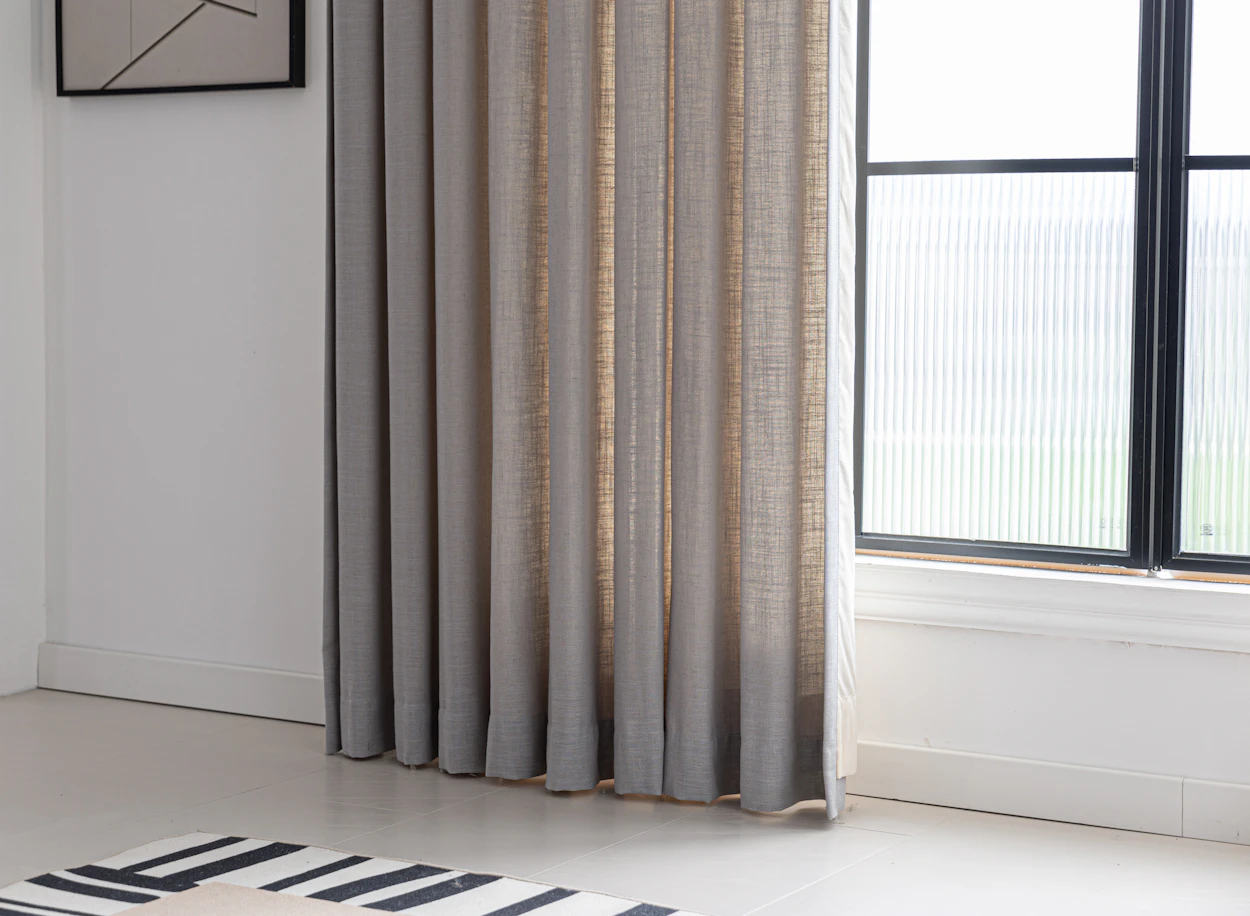
Draw the opening and the available travel
Measure the window where you want the treatment to cover it, then sketch the wall space out to the nearest corner, cabinet or door swing. Mark handles, protruding sills and anything that limits where fabric can hang. Put letters on the drawing for the glass width, the trim width and the running width of the hardware. These can all differ. On an existing rod, note where the rings actually stop; the finials and any sections the rings cannot pass do not give you additional travel.
Choose how the curtain will open before sharing the travel between panels. Two panels can frame the center, but a single draw may suit a window pressed into a corner. Check whether a center bracket blocks the movement you need. For a replacement, write down the heading and what is already fitted rather than assuming that eyelets, rings and track hooks share the same usable width or length. If choosing hardware, follow its instructions for span, weight and mounting; where young children are present, choose cordless window coverings as recommended by the U.S. Consumer Product Safety Commission.
Separate covered width from flat fabric width
First decide the width the treatment must cover when shut. Think through the left panel and right panel separately. Does the heading allow the leading edges to overlap? Do the outer cloth edges need to return toward the wall, and is there a way to attach those returns? A curtain whose edges just touch on paper may leave a narrow sliver of view where the heading holds them apart. Confirm any extra overlap or return is physically possible with your hardware instead of just adding more flat cloth to the order.
For an ungathered panel that you will arrange yourself, divide the total flat fabric width by the closed span it actually has to cover to describe its fullness. Twice as much flat width as covered width is one possible starting point for a fabric that you want to fall in folds; it is not a rule for every heading. Ask how the seller measures the listing. A fixed pleated heading may already be sized by the width it covers, while an ungathered panel is often listed by its flat width. Confirm whether a package gives one panel's width or the sum of two. For fixed systems use the maker's stated coverages rather than multiplying a number already gathered.
Make room for the open folds
Stack-back is the space a panel takes up when open. Check both the width of the folded bundle along the rod and the depth it projects into the room. Moving a heavy panel farther from the glass may need wall space it does not have near a corner or a bookcase. An eyelet panel may also project behind the rod where the loops turn. If keeping daylight is important, estimate how much of each bundle can sit beyond the area of glass; the remainder is glass you may lose even with the curtain fully open.
Use an existing panel of similar heading and weight as a rough guide, or ask for the seller's stack-back measurements for the intended construction. Pinching a strip of scrap gives you some sense of fold depth but does not model a full lined panel. Reduce fullness only if the result still closes with the appearance and coverage you want. Sometimes a one way draw toward the side with more wall gives a better result. If more projection would block a handle or leave nowhere for the fabric at one end, consider a different heading or a better suited window treatment before changing the length.
Calculate a pair, then test the limiting side
Suppose a window has 44 inches of glass and a rod gives 60 inches of usable coverage, centered on the glass. That leaves 8 inches on each side between the edge of the glass and the outer coverage point. In a layout with a feasible 2 inch center overlap and no wall returns, each symmetrical panel must cover 31 inches when closed: half of the 60 inch span plus one inch. Two 54 inch flat panels give 108 divided by 62, or about 1.74 times the required coverage. Whether that gives the shape you want depends on the fabric and heading.
Suppose the maker then estimates that each open panel uses 11 inches along the rod. With only 8 inches beyond either edge of the glass, about 3 inches per side would still cover glass in this simplified layout. Before looking for larger panels to create more folds, identify which dimension matters more: the fuller closed appearance or the clear pane when open. A longer rod might help only if there is room on the wall and appropriate support. If a cabinet cuts the right side short, redraw the two sides separately instead of treating the total extra width as if it were always evenly available.
Measure length from the real suspension point
If you are sizing a sill length panel, check where the sill projects relative to the cloth. A hem that clears it vertically can still catch as the folds move if the track sits close to the frame. Use the actual heading and a hanging sample to see where the fabric falls.
Work out where the panel's listed top edge will sit when hung. A hook can hold some fabric above its suspension point, and a ring and clip can lower the fabric below the rod. Measure to the intended hem on the left, center and right, especially if the floor or sill slopes. Choose how much clearance you want where the distance is shortest, then apply the heading offset using the product drawing. For a daily opening next to furniture or a busy passage, trial a hem that clears the obstacle rather than assuming a pooled length will stay where you put it.
Hang the unaltered panels first where returns permit. Close them and check the center from both sides of the room, open them fully and see how much glass the stacks cover, then operate the window in the way you usually do. Look at the lowest point of the hem as the panel moves, not just when it is parked. Save the actual coverage and the flat label dimensions together for any future replacement. Do not trim a hem until you know the heading is right and have considered any change in length under the permitted care routine.