Fabric Notes / Guide
Tell woven fabric from knit in an unlabelled scrap
Follow a thread or a loop at a cut edge before trusting the stretch you feel in your hand.
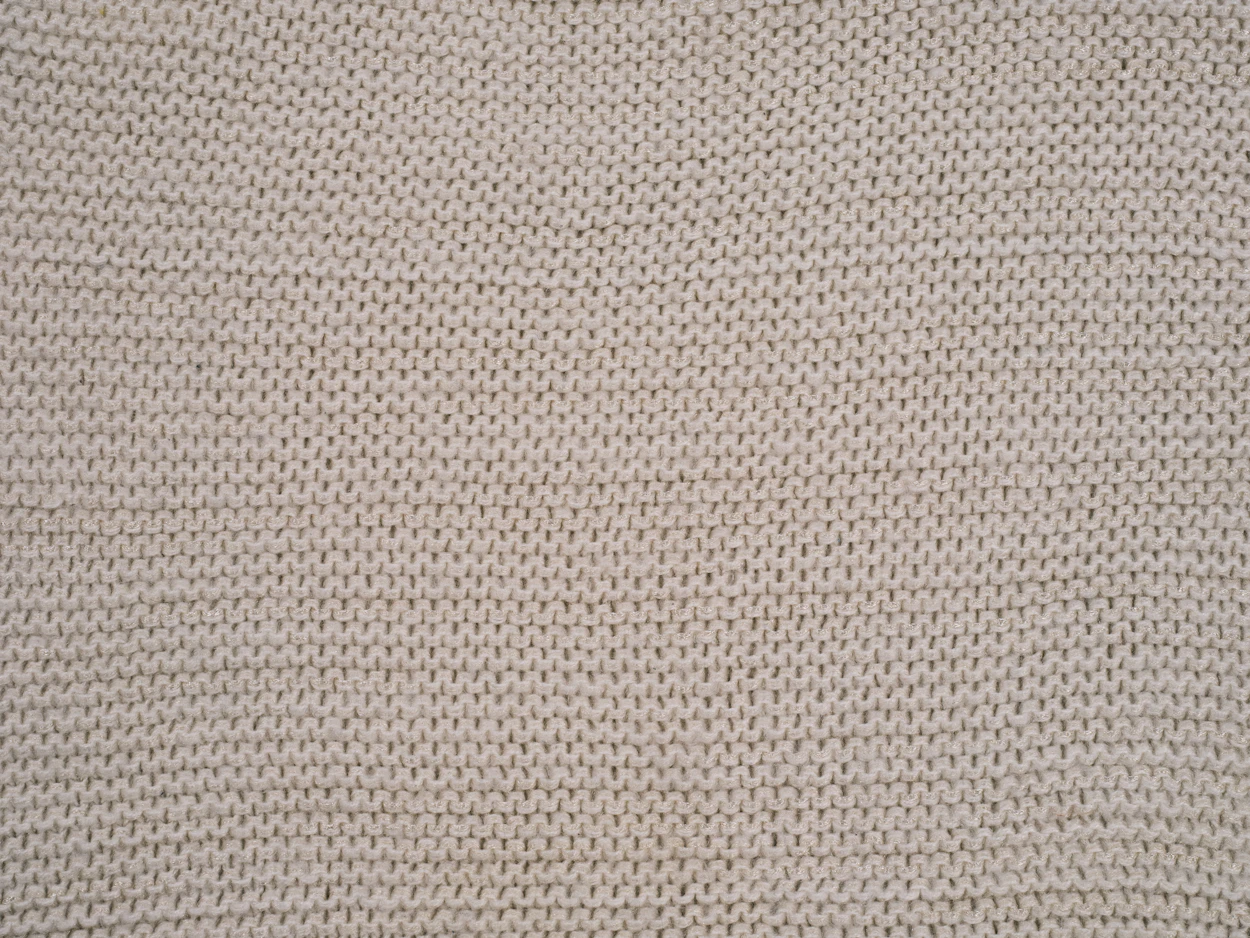
Find two useful reference fabrics
Set the mystery piece beside an ordinary woven pillowcase and a plain jersey T-shirt. Look at an unseamed area on each with light coming from one side. On the pillowcase, straight lengthwise and crosswise yarns pass over and under one another. On the face of many jersey fabrics, small V shapes sit in vertical columns; the reverse can show arcs or bumps instead. These references give your eye a scale for what to look at. Rib knits and double knits can look quite different from a T-shirt, and a woven twill does not look exactly like a pillowcase.
Spread the unknown piece without stretching it. Check both sides, preferably at a place without a print or raised texture, then enlarge the view with a phone camera or a magnifier. Follow one visible strand through several repetitions. Does it stay in its lane, crossing strands that run another way, or does it bend into repeated loops held by other loops? Look for the structure under the printed design: a printed stripe can run slightly off the yarn direction, and fake rib marks can be part of a print.
Inspect a cut edge that can be spared
On an expendable scrap, snip a tiny straight cut parallel to a visible direction and tease at the strands with the tip of a pin. A woven edge cut along the yarns may let you lift a short length of one yarn in a line or bring out a little fringe. Look at where it came from: the crossing yarns remain in place and the exposed ones point at the gap. Try the direction across the first cut if the edge you started with was at a slant or came from a tightly bound selvage.
At a knit edge, look for loops that join other loops. A loop that opens may loosen neighbouring loops or leave a little ladder, depending on the construction and cut direction. Some knits curl enough that it is easier to put the sample under a clear ruler to examine it. Fray, curling and unravelling are clues, not requirements. A tightly made or fuzzy fabric may give away very little at the cut edge. On a finished garment, use magnification on an inside seam allowance rather than opening the seam or pulling out threads.
Stretch along three lines, with a light touch
Pick two points several inches apart in the direction of one apparent thread line. Grip close to the marks and ease them apart; release them before repeating across the cloth and on a diagonal. Keep the pull light enough that you are not deforming the sample. Watch what moves between your hands. On a plain woven fabric, the straight directions may move very little but the diagonal can give as the threads change their angle to each other. On many jersey knits the crosswise loop direction gives more readily than the length direction.
Stretch alone cannot settle the question. An elastic yarn can make a woven cloth stretch noticeably in a straight direction. A stable double knit, a tightly constructed warp knit or a knit with a bonded surface may show surprisingly little give. Also, a biased cut scrap can feel stretchy both ways if what you call its length and width happen to be diagonal to the actual yarns. Use what you can see of the structure to interpret what you feel, and write down the direction you pulled rather than just calling the sample stretchy.
Work through a deceptively stretchy scrap
Suppose a charcoal remnant from a trouser hem gives easily when pulled across the width and snaps back when released. Its face has fine diagonals, which could be a surface pattern rather than an answer. In a magnified view on the reverse, you find uninterrupted lengthwise strands crossed by a second set. At a spare edge, a teased strand lifts in a straight line and reveals the ends of cross threads. That points to a woven construction with crosswise give. It does not establish that the stretch comes from elastane or tell you how much of it is present.
Mark the direction of greatest give and decide where it would help. In a fitted woven piece it might belong around the body rather than along its length, if the pattern permits. If the remnant is for a pocket facing, compare how its give matches the main cloth. For a repair, use an offcut from the same garment if one is available without disturbing construction. A patch that stops the garment stretching at one point can feel restrictive even when its colour and thickness are right.
Name the uncertainty when surfaces hide the answer
A brushed cloth can conceal its yarns beneath a soft pile. Turn it over or spread the fibres gently with a blunt point in a spot that will not show. A laminated cloth can have a different surface on each side or two fabrics joined together; identify the part you can see and make a note of the rest. Compare it with a labelled cloth from a supplier if you need a more certain classification. Some materials, including many felts and interfacings, may not show either an interlaced grid or an orderly chain of loops.
It is perfectly useful to label a scrap as unknown construction with low lengthwise give and visible loops on the reverse, rather than forcing it into a familiar category. For an item that depends on a closely specified stretch, buy labelled material and check the pattern's stretch gauge. A scrap may still be useful for making a paper pattern weight cover, a practice seam or a small decorative patch. Choose a job where your remaining uncertainty doesn't control fit or care.
Turn the identification into a sewing choice
Put a chalk arrow along an actual yarn line or loop column on the reverse. Add a second arrow or note for the direction that extends most, including whether it returns to its starting span readily. Record what you saw under magnification. Check at a second spot: decorative weaves or knits may have a less confusing area near a plain margin. Do not guess the original direction of the bolt from the longest cut edge of an offcut; it may have been cut to fit something else.
For a project, sew a short mock seam running in the relevant direction, using a needle and stitch suited to the material and your machine. Open it as the planned item will open. On a knit that needs to expand, check that neither the stitch nor the cloth gives way at the required extension. On a woven that needs a flat edge, look for distortion where you feed it. Classification is useful when it points you to a workable layout and seam, even when the fibre blend remains a mystery.